Home › Demolition & Removal in Vancouver, WA
Demolition in Vancouver, WA. Vancouver Excavation Co. tears out structures, concrete, and old foundations and hauls the debris off. Free estimates, licensed and insured.
Demolition in Vancouver, WA means dealing with a housing stock that in many neighborhoods dates to the 1940s wartime expansion, when Vancouver's population jumped from 18,000 to over 80,000 in a matter of months and thousands of homes went up fast. Vancouver Excavation Co. handles residential and light commercial demolition across Clark County, including garages, sheds, outbuildings, old foundations, concrete slabs, patios, and decks on those mid-century lots. We take it down, load it out, and leave the site clean and level.
A careful teardown on an older Clark County lot starts well before the machine reaches the structure. Power, gas, water, and sewer have to be officially disconnected or capped first, because mid-century homes in Fruit Valley, Bagley Downs, and McLoughlin Heights were largely built when oil-fired heating was standard, and buried fuel oil tanks are common on those lots. Materials need to be sorted for proper disposal, and anything unusual below grade has to be identified before excavation goes deep. We treat demolition as the first phase of site preparation, not just a removal job, so the finished site is clean and buildable.
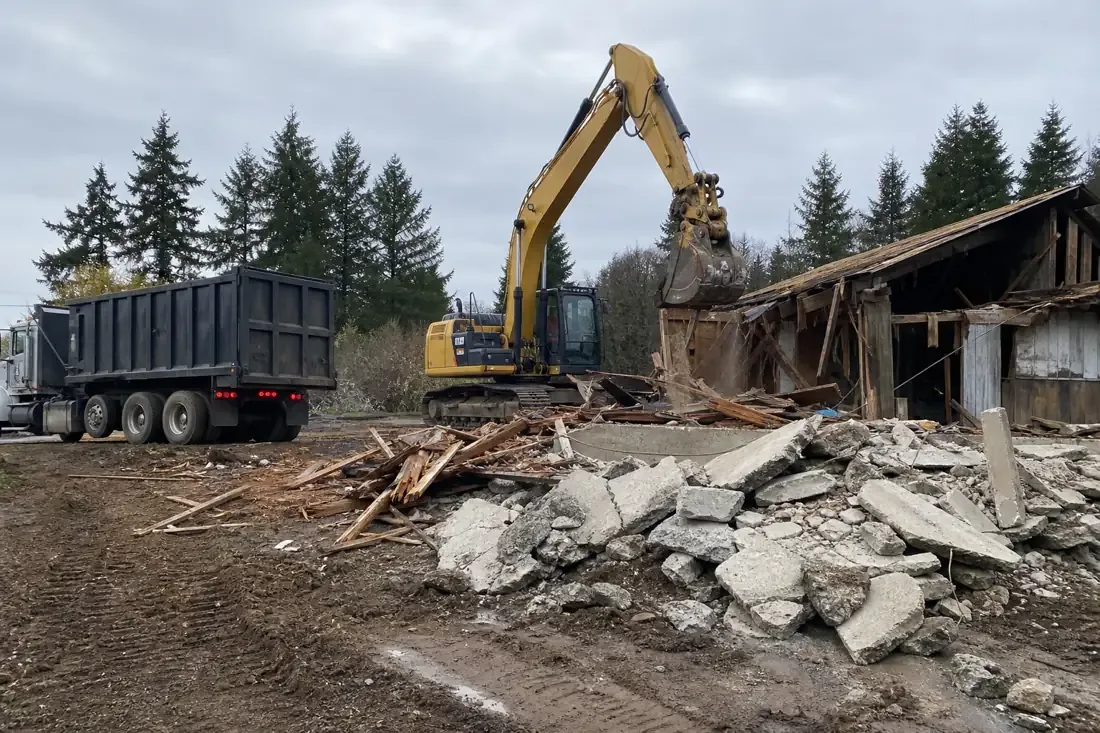
We take the structure down, break out what is under it, load it, and get it off the property. On older Vancouver lots that often means finding things nobody knew were buried. Our demolition and removal work covers:
The measure of a good demolition is what the lot looks like when the last truck leaves. Utility disconnects and caps happen before any removal begins. On mid-century Clark County properties, we look specifically for buried heating-oil tanks, decommissioned septic systems, and older foundations before excavation goes deep. The structure comes down with equipment matched to the job; concrete, metal, wood, and mixed debris go to the right destinations. Old slabs and footings are pulled out rather than buried. The finished site is level, clean, and free of subsurface material that would interfere with the next phase.
The wartime developments of the 1940s — Fruit Valley, Bagley Downs, McLoughlin Heights, and others built during the Kaiser Shipyard boom — put a large amount of housing on the ground quickly, and many of those lots still carry buried heating-oil tanks from the original oil-fired furnaces. Septic components, abandoned wells, and older buried footings are also common on mid-century Clark County properties. We look for these conditions as excavation progresses, handle discoveries responsibly, and bring in a licensed specialist for tank decommissioning or septic closure rather than treating it as standard debris removal.
Vancouver demolition ranges from mid-century residential tear-outs to light commercial removal. In the wartime neighborhoods of McLoughlin Heights, Bagley Downs, and Fruit Valley, the work is usually garages, additions, old patios, sheds, and worn-out slabs on tight postwar lots. Around Orchards and Cascade Park, redevelopment means clearing older outbuildings before infill construction. Out toward Battle Ground and Camas, rural demolition covers old barns, farmstead outbuildings, and structures that have outlasted their use. Each setting brings different utility disconnect requirements, access conditions, and debris volumes. or build. We handle all of it.
Vancouver's 1940s wartime expansion built thousands of homes across Fruit Valley, Bagley Downs, McLoughlin Heights, and nearby developments at a pace that prioritized speed over documentation. A large share of that housing used oil-fired heat, and buried fuel tanks on those lots were often forgotten rather than properly decommissioned as heating systems changed over the decades. We go into older Clark County demolition work aware of that history, watch excavation for signs of buried tanks or septic infrastructure, and bring in a licensed specialist for decommissioning rather than treating it as ordinary material removal.
Teardowns here generally run $1,500 to $12,000. The structure itself matters less than what it is made of and how much of it has to leave in a truck. A shed, patio, or slab is quick work at the low end. A house, barn, or old reinforced foundation climbs fast, because rebar-laden concrete is slow to break and expensive to dump. On mid-century lots we also plan for the surprises — buried oil tanks, old septic, and utility disconnects that have to happen before anything comes down. Clark County ranges are below.
| Demolition scope | Typical size | Typical Vancouver cost |
|---|---|---|
| Shed / small outbuilding | per structure | $800 – $3,000 |
| Garage / barn | per structure | $3,000 – $10,000 |
| Concrete slab / driveway | per project | $1,200 – $5,000 |
| Old foundation removal | per project | $2,000 – $8,000 |
| Debris haul-off | per load | $400 – $1,200 |
Figures reflect Clark County teardowns and include knocking it down, loading out, and disposal. What shifts them: how big the structure is, whether the concrete is reinforced, what the transfer station charges, and how close a machine can park. Firm itemized quote after we walk it.
Most Vancouver structural demolition requires a Clark County demolition permit. Before teardown, power, gas, water, and sewer need official disconnects or caps from the serving utility or under a separate permit. Washington State rules administered by the Department of Ecology may require an asbestos notification or survey before work begins on older structures — particularly pre-1980 buildings, where disturbing asbestos-containing materials without proper handling is a regulatory violation. Vancouver Excavation Co. manages the demolition permit, coordinates the disconnect sequence with each utility, and identifies any survey requirements so the removal stays legal and safe.
We inspect the structure or concrete, verify utilities and access, and provide a written itemized demolition quote.
The demolition permit, utility disconnect sequence, and any required survey are coordinated before teardown starts.
Our crew removes the structure or concrete with properly sized equipment and loads debris for haul-off as the work progresses.
Debris is trucked out, old foundations are excavated as needed, and the site is left clean and level for the next phase.
Expect $1,500 to $12,000 for most residential demolition in this area. Small slabs, patios, and sheds sit at the bottom. Garages, outbuildings, houses, and reinforced concrete sit higher — machine hours, sorting materials for disposal, trucking, and tipping fees all stack up. Before quoting we check access, confirm the utility disconnects, and look at what the structure is actually built from.
Yes. We load out everything the teardown produces — sorting concrete, metal, wood, and mixed debris for the appropriate disposal or recycling destination. Old slabs and buried foundations are removed rather than left in place where they would interfere with grading or future construction. On mid-century Clark County lots we also look for below-grade material like buried oil tanks, septic components, or abandoned utility lines that need proper handling rather than being covered over. The goal is a site that is clean, level, and free of hidden problems for the next crew.
Usually. Clark County demolition typically requires a demolition permit, official utility disconnects from each serving utility, and — for pre-1980 structures — potentially an asbestos notification or survey under Washington Department of Ecology rules before work begins. We help coordinate the permit, the disconnect sequence, and any survey requirements so the teardown does not create a regulatory or safety issue.
Yes — driveways, patios, sidewalks, slabs, footings, and old foundations, rebar included. It is worth getting all of it out rather than burying the broken pieces on site. Concrete left in the ground shows up later as a spot that will not compact, a drain line that has to jog around it, or a footing that lands on something unexpected.
Older Clark County lots — especially those built during the 1940s wartime expansion in Fruit Valley, Bagley Downs, and McLoughlin Heights — regularly produce buried oil tanks, decommissioned septic systems, abandoned wells, or old footings during demolition. We work with that history in mind on any pre-1960 property, slow down when excavation shows signs of buried infrastructure, and bring in a licensed specialist for tank decommissioning or septic closure rather than treating it as a standard material-removal job.
Tell us what is coming down and what stays. We will look at access, disconnects, and disposal on site, then quote the teardown in writing. Call, text, or use the form — we reply the same business day.
Call or text to reach our team directly. During business hours we pick up when we can, and every message gets a return call.
(360) 226-9991Hours: Mon–Sat, 7am–6pm