Home › Grading & Leveling in Vancouver, WA
Grading and site leveling in Vancouver, WA. Vancouver Excavation Co. shapes ground for drainage, driveways, pads, and yards — elevations held to a tenth of a foot. Free estimates, licensed and insured.
Grading and leveling in Vancouver means accounting for 42 inches of rain a year. Sitting at roughly 180 feet above sea level on a low terrace just north of the Columbia River, the city carries runoff from fall through spring — and ground that is not shaped with intentional fall sends that water into crawl spaces and foundations. Vancouver Excavation Co. grades pads, yards, driveways, and commercial sites to planned elevations with positive fall built in, so winter rain moves toward an outfall rather than a structure.
In Vancouver, grade is not just about making dirt look level. Clark County receives about 42 inches of rain concentrated in fall, winter, and spring, with a dry window from mid-June through September. Low areas near Burnt Bridge Creek and Salmon Creek stay wet into spring, and neighborhoods like Hazel Dell and Fourth Plain — built during the WWII-era housing rush — now show settled grade, failed drainage, and yards that pool before each storm passes. A small slope mistake on any of these sites sends water toward a structure instead of away from it.
From leveling a back yard to cutting a site to engineered plan elevations, the goal is the same: ground that drains and holds its shape. Our grading work covers:
In Clark County, ground that looks flat can still fail if the fall sends water toward a structure instead of away from it. We have regraded settled lots in Hazel Dell, Orchards, and Salmon Creek neighborhoods, and new rural pads near Battle Ground and Camas. The constant is drainage: work sets positive slope away from buildings, uses swales to carry runoff toward a legal outfall, and compacts grade as it goes so winter rains do not create new low spots in fill that was never properly consolidated.
A blade pass makes ground look level; it does not make it stay level. Uncompacted fill settles, and with 42 inches of rain landing on it each year, the first wet season finds every soft lift. We build grade up in compacted layers so the elevation we hand over is the elevation you still have in three years.
Vancouver spans more terrain than a city at 180 feet suggests. The Columbia River bottomland keeps the west side low and slow-draining, while neighborhoods like Orchards, Cascade Park, and Hazel Dell sit on higher ground that sheds runoff toward the river corridor. At that average elevation, a few inches of misgrade makes a real difference — water without a clear downhill path finds the nearest foundation instead. We set the fall deliberately, from stake to stake across the full site, not by estimating from the seat of the machine.
The areas closest to the Columbia River and Burnt Bridge Creek carry a real wetland history. Ground that was saturated, filled, or regraded during Vancouver's rapid WWII-era expansion — particularly in Fruit Valley and the developments built for shipyard workers — does not compact or drain uniformly. We shoot elevations across the full site, account for low corners and old fill contours, and cut grade toward a real outfall rather than smoothing the surface and leaving the water nowhere to go.
Residential grading here generally runs $1,200 to $5,500. What sets the number is how much soil is moving, how tight the finish tolerance has to be, whether a machine can reach the work, and whether material has to be trucked in. Machine and operator time is about $110 to $190 per hour; finish grading is often priced by area instead. Imported fill or rock adds roughly $35 to $60 per ton delivered and placed. Typical Clark County ranges below.
| Grading scope | Typical size | Typical Vancouver cost |
|---|---|---|
| Yard leveling (small) | up to 1/4 acre | $1,200 – $3,000 |
| Driveway / pad grading | per project | $1,500 – $4,500 |
| Rough + finish grade (lot) | 1/4 – 1/2 acre | $2,500 – $7,500 |
| Drainage regrade w/ swales | per project | $2,000 – $6,000 |
| Imported fill / rock | add-on | +$35 – $60 / ton |
Clark County figures covering the shaping work and cleanup afterward. Volume of material, how fine the finish needs to be, how wet the ground is when we start, and any imported fill are what move them. Firm itemized quote after a free visit.
When a Vancouver grading job moves enough soil, the City of Vancouver or Clark County may require a grading permit. Once significant ground is disturbed, Washington stormwater rules require erosion and sediment controls to keep runoff from carrying soil into Burnt Bridge Creek or the public storm system. Vancouver Excavation Co. checks which jurisdiction applies, pulls any required permits, and installs silt fence, wattles, or other controls before the work starts — not after an inspector asks.
We visit the site, shoot elevations, study drainage and access, and turn the grading scope into a written itemized quote.
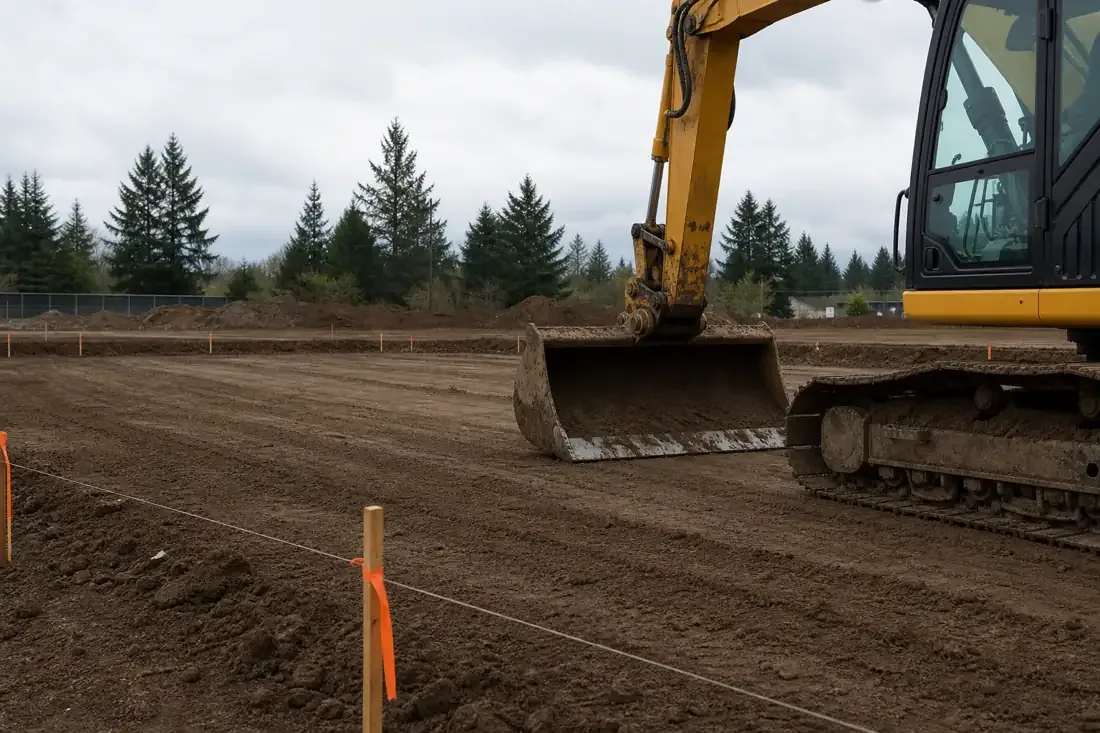
Grade stakes or lasers are set from the plan, and any permit or erosion-control requirement is handled before the work starts.
The crew moves material, forms the drainage pattern and finished grade, and compacts during placement so the new shape holds.
Final elevations are checked against the plan, and the site is left clean, draining correctly, and ready for the next trade.
Expect $1,200 to $5,500 for most residential grading. A straightforward yard level starts near the bottom of that; full rough-and-finish work, cutting drainage swales, or balancing a sloped lot sits higher. Equipment with an operator is typically $110 to $190 per hour, though finish grading is often quoted by area. We confirm after looking at slope, access, and what the soil is doing.
Rough grading is the bulk work — relocating soil, forming contours, bringing the site close to plan elevation. Finish grading is the precision pass that follows, tightening pads, driveways, lawns, and drainage surfaces to within about a tenth of a foot. Most jobs around here need both, because on ground this flat a tenth of a foot is the difference between water leaving and water sitting.
Often yes, if what you have is a surface-water or slope problem. We can rebuild fall so water moves away from the house, cut swales to carry it, and aim the runoff at a legal discharge point. But if the water is coming up from below rather than running across the top, reshaping alone will not fix it — that case wants grading paired with a French drain, catch basin, or downspout tie-in so the new contours have somewhere to deliver the water.
If the work moves meaningful soil, usually yes. The City of Vancouver or Clark County may require a grading permit, and Washington State erosion-control and stormwater rules apply once ground is disturbed. We check the jurisdiction, pull the permits the job needs, and install erosion control before runoff can leave the site.
A basic regrade or yard leveling is usually one to two days once layout and any permits are sorted. Bigger pads, balancing a slope, cutting swales, trucking in fill, or working saturated winter clay stretch that to several days. We schedule against compaction conditions rather than the calendar — soil forced into place wet gives you a grade that fails quietly a season later.
Describe the area and what it needs to do when we are finished. We will walk the fall with you, shoot elevations, and quote the shaping in writing. Call, text, or send the form — we reply the same business day.
Call or text to reach our team directly. During business hours we pick up when we can, and every message gets a return call.
(360) 226-9991Hours: Mon–Sat, 7am–6pm