Home › Site Preparation in Vancouver, WA
Site preparation and build-ready pad work in Vancouver, WA. Vancouver Excavation Co. clears, cuts, fills, grades, and compacts lots across Clark County. Free estimates, licensed and insured.
Site preparation in Vancouver starts well before any dirt moves. Clark County averages around 42 inches of rain annually, nearly all of it falling between October and June, so a pad that gets built in the wrong weather window ends up fighting saturated clay instead of compacting it. Vancouver Excavation Co. clears, grubs, cuts, fills, and compacts lots so they are foundation-ready by the time your builder needs them — homesites, ADUs, shop pads, and light commercial ground across the county.
The work looks different depending on where in Clark County the lot sits. Low ground near the Columbia River and along Burnt Bridge Creek can stay soft well into May, while higher residential areas in Felida and Cascade Park bring slope, runoff, and deeper cut-and-fill into the job. The county's clay and seasonal groundwater mean a pad only performs if it is built from the subgrade up — drainage in, organics out, fill compacted in lifts.
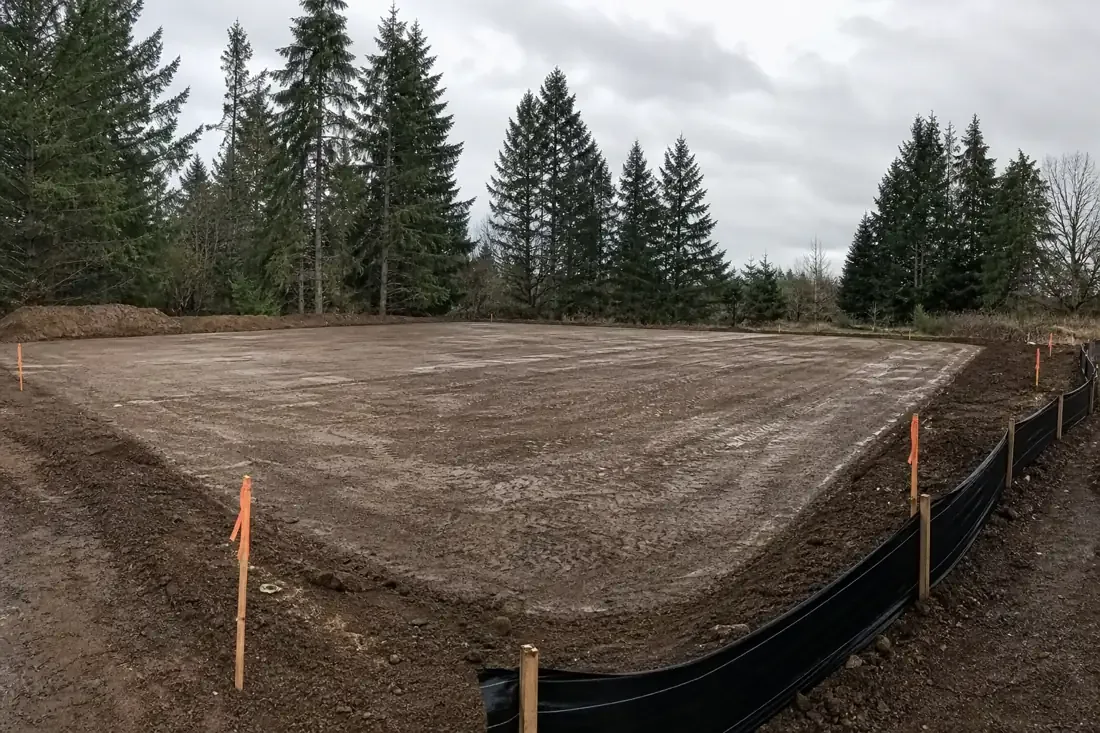
From the first stripping pass through final compaction, we turn raw ground into a work area the foundation crew can build on without arguing about elevation. A typical residential scope covers:
Clark County site prep covers a wide range of conditions. An infill lot in Bagley Downs or McLoughlin Heights may carry aging utility lines, buried oil tanks, and saturated clay just below sod, while a newer parcel in Salmon Creek or Battle Ground might need a full cut-and-fill before a foundation can sit level. We walk the lot, assess soil, slope, access, and drainage, then build the pad in compacted lifts designed to hold through a Clark County winter.
The dry window from mid-June through September is when Clark County pads compact cleanly. Clay that holds water through the wet season firms up once the rains stop, and that is the period when fill lifts seat properly, subgrade bears the way the geotech report assumes, and drainage shapes hold after grading. We time the work to match conditions and build sufficient drainage into the pad so the first wet season does not undo what we built.
For most Clark County residential pads, site preparation runs in the $2,500 to $8,000 range. The final number depends on lot size, the volume of cut and fill, slope, access, and how much the soil or rock pushes back. Excavator time with an operator runs roughly $110 to $190 per hour, crushed rock for a stable base comes in at about $35 to $60 per ton delivered and placed, and spoil removal runs about $60 to $120 per cubic yard. The table below shows planning ranges for Clark County before we visit the site.
| Site prep scope | Typical size | Typical Vancouver cost |
|---|---|---|
| Small pad (shop, ADU, garage) | up to 1,000 sq ft | $1,800 – $4,500 |
| Single-family home pad | 1/4 – 1/2 acre | $2,500 – $8,000 |
| Cut & fill on a sloped lot | varies | $4,000 – $14,000 |
| Over-excavation + imported rock | per project | +$1,500 – $6,000 |
| Erosion control setup | per site | $600 – $2,000 |
Numbers reflect typical Clark County pad and site-prep scopes including excavation, grading, and cleanup. Rocky ground, steep access, poor equipment reach, or heavy wet-season saturation all push costs upward. After a free site visit we provide a firm, written quote with line-item detail and no obligation.
When site prep in Vancouver involves real soil movement, the permit path typically runs through a City of Vancouver or Clark County grading permit. Washington State stormwater rules apply on disturbed sites, and under RCW 19.122.030 we must mark the excavation boundary with white lining and notify all underground facility operators through 811 at least two full business days before breaking ground. Vancouver Excavation Co. handles the permit filings, installs the required erosion controls, and keeps them in place through final inspection.
Your estimate starts on site: we review the plans, check pad elevation and drainage path, assess soil and slope, and discuss timing relative to the dry season — then price the work line by line in writing.
Before dirt moves, we secure the grading permit and install erosion controls so the first cut is made under the right approvals.
The crew strips organics, cuts or fills to grade, and compacts the pad in controlled lifts — each layer tested and seated before the next one goes down. The site stays organized each day so drainage and subgrade aren't compromised between passes.
Before handoff, we check the grade and compaction, square up the pad, and leave your foundation crew a clean place to start.
For most Clark County homesites, site preparation runs between $2,500 and $8,000. Equipment and operator time is usually $110 to $190 per hour, spoil haul-off is commonly $60 to $120 per cubic yard, and smaller ADU or shop pads can start around $1,800. Deep cut-and-fill, wet over-excavation, or imported base rock pushes the total up, so we price it after walking the ground.
The job turns raw ground into a foundation-ready surface. That means stripping brush, sod, roots, and organics down to stable subgrade; cutting or filling to planned elevation; shaping rough and finish grade so water runs away from the structure; compacting the pad in lifts; and installing erosion controls before the first rain. If the Clark County clay is too soft or too wet, we remove and replace the bearing zone with compacted rock.
Once permits are in hand, a typical Clark County residential pad takes one to three working days. A lot with heavy cut-and-fill, significant rock, or saturated clay can run longer. The real scheduling lever is the annual dry window: from mid-June through September the ground firms, clay compacts reliably, and equipment access on steep lots improves considerably. We tell you honestly whether the timing works or whether the job should wait for better conditions.
Real soil-moving almost always requires paperwork in Clark County. The City of Vancouver or the county may require a grading permit, Washington State stormwater rules cover disturbed ground, and RCW 19.122.030 requires marking the excavation boundary and notifying 811 before breaking ground. We identify what applies, pull the permits, set erosion controls, and keep the inspection documentation current.
Yes, but the approach has to change. Clark County's wet season runs from October through mid-June, and cold east winds off the Columbia River Gorge can bring a silver thaw — freezing rain on already saturated clay — that shuts down compaction work entirely. We adjust access, drainage, and sequencing to fit the conditions, and we tell you directly if the window is too narrow to produce a pad that will hold.
Give us the basics and we will come out, look at the lot with you, and put the full scope in writing — timing, materials, and price, no pressure. Call, text, or use the form; we reply the same business day.
Call or text to reach our team directly. During business hours we pick up when we can, and every message gets a return call.
(360) 226-9991Hours: Mon–Sat, 7am–6pm